
Dover’s Upcoming Repaving Projects
Looking for opportunities to make Dover’s streets safer and more versatile in their upcoming repaving plans


At our recent meeting we reviewed Dover’s plans to repave several streets during 2026 in an effort to try to get ahead with recommendations and feedback on how to modify them. Our goal is to look for opportunities to make the streets safer while also expanding biking and walking access. We did this same process last year, albeit a bit late in the year. Due to our late start one of our recommendations was refused on the basis that an engineering study would need to be done, but there wasn’t time or funding to do one. Our hope is that we can get an early start here and be able to handle such requirements if they show up again.
2026 January Meeting Details
Our in-person meetings are where we gather to discuss issues that we observe in our local towns and progress we have made on active projects. Join in for the conversation and if you’d like to bring a topic of your own, just let me know.
Exeter Meeting
Wednesday, January 7th 6:30PM
Exeter Library
4 Chestnut St
Exeter, NH
Seacoast Meeting
Monday, January 12th 6:30PM
Juniper Kitchen
6 Third St,
Dover, NH
Seacoast Social
Monday, January 12th, immediately following Seacoast meeting (~8PM)
Cara Irish Pub & Restaurant
11 Fourth St
Dover, NH
The Opportunity In Repaving
Dover’s Transportation Master Plan included an action item to leverage regular street maintenance as an opportunity to improve paint-based bicycle and pedestrian facilities. This manifested as Dover’s Bicycle Friendly Streetscapes Guidelines (BFSG), which our group reviewed last year and recommended changes which were largely endorsed by the Dover’s Transportation Advisory Commission (TAC). Changing painted lines might seem like a small change to a street, but much of the functional intentions of a street are dictated by paint alone. Turning lanes, shoulder and lane widths, crosswalks, bike lanes, sharrows, and other features of a street are just paint. This is incredibly cost effective for the city as they effectively spend no additional money to achieve safer and more productive streets with just the swipe of a paint brush. We are taking this as a chance to reimagine these streets and what sorts of designs would slow down traffic while also promoting walking and biking.
The list of streets up for repaving in 2026 that the city has shared with us includes 13 streets, and is subject to change. Most of the streets are unstriped residential streets that we don’t have much comment on, but there were four streets that we believe could benefit from a change in paint.
Atlantic Avenue
Horne Street - Ash to Glenwood
Durham Road - Mast to Bridge
Bellamy Road - Alumni to Durham Road
Atlantic Avenue
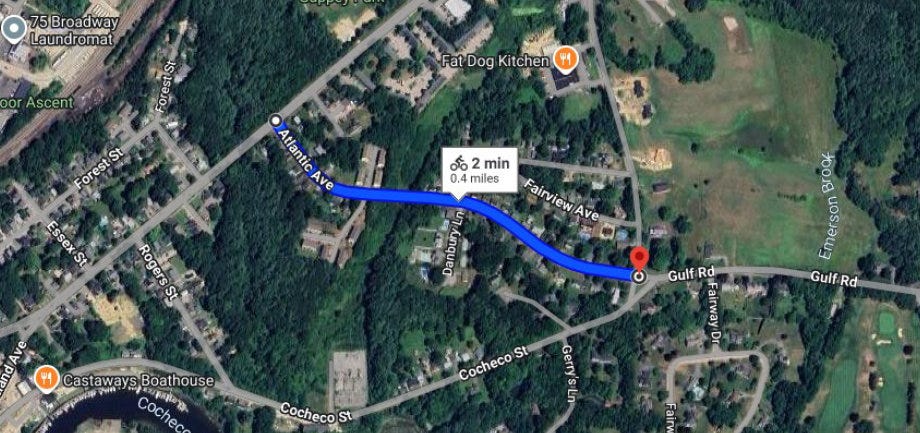
Atlantic’s Current Conditions
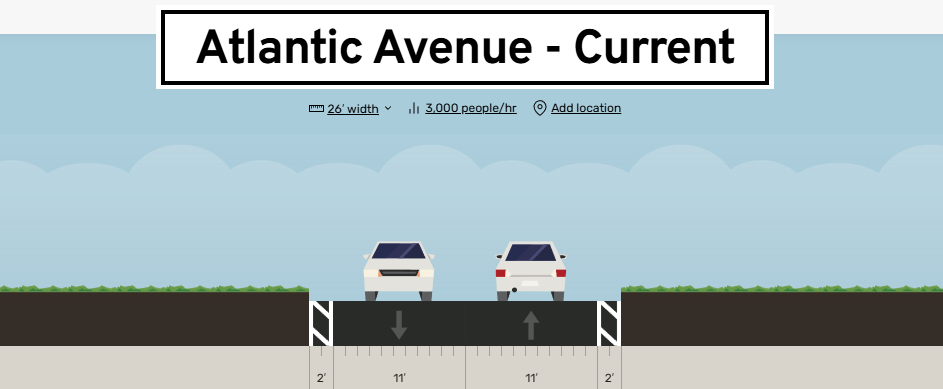
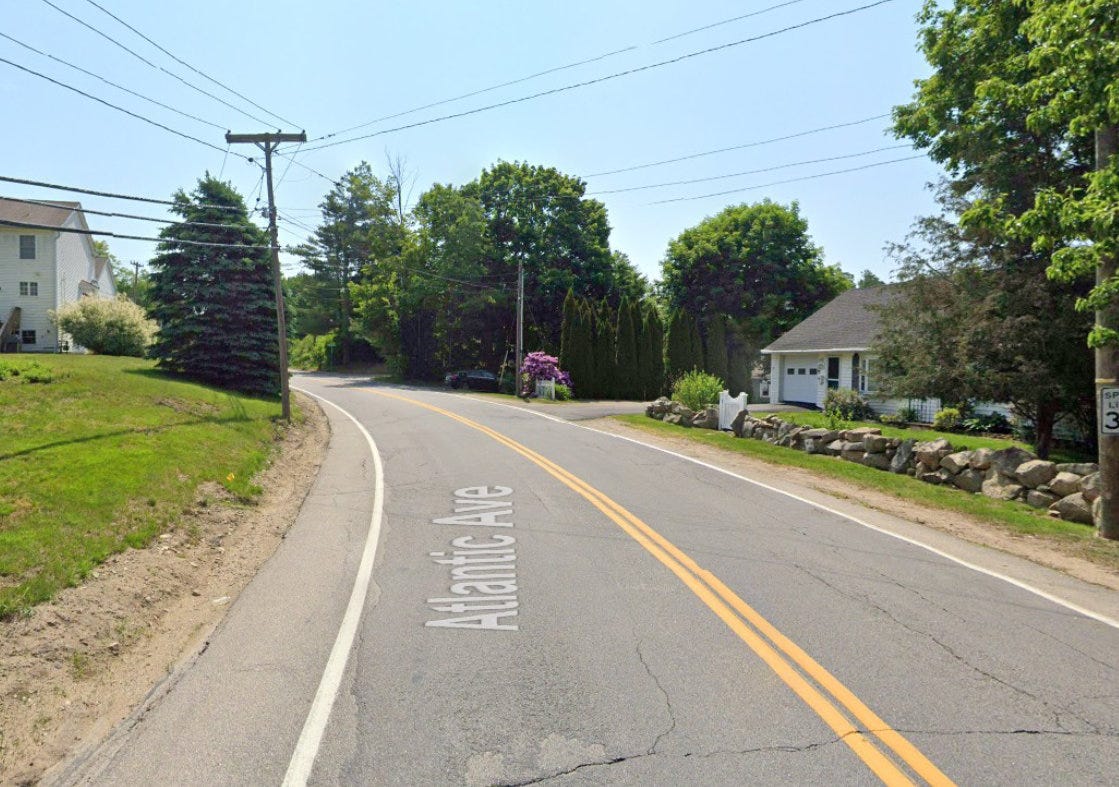
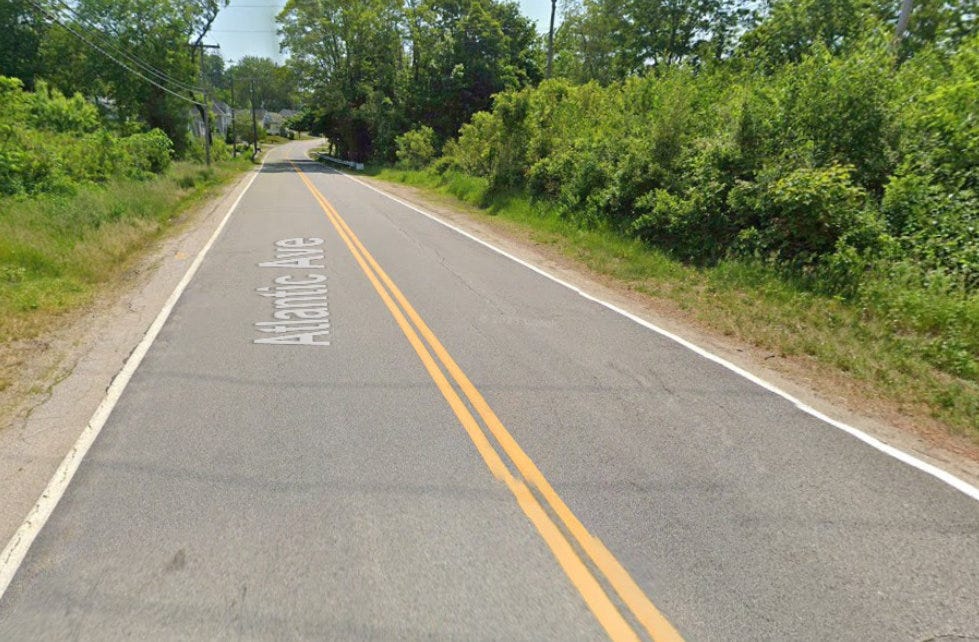
A typical two lane street with very narrow shoulders. There is a sidewalk on a small portion of the street, but for the most part there is no walking infrastructure on the street. The BFSG recommends sharrows for a street like this, and Dover’s Transportation Chapter in their Master Plan recommends widening shoulders in lieu of sidewalks.
At Dover’s most recent Transportation Advisory Commission (TAC) Dover City Councilor Robert Warach had an item on the agenda pertaining to Atlantic Avenue and traffic speeds. GPS data was showing that the street regularly experienced speeds between 31mph and 36mph, which is above its posted speed limit of 30mph. The TAC recommended reducing travel lane widths to 10’ in the upcoming repaving effort. Narrowed travel lanes on streets with 30mph - 35mph traffic show a reduction in crashes according a Johns Hopkins study.
Recommendations for Atlantic
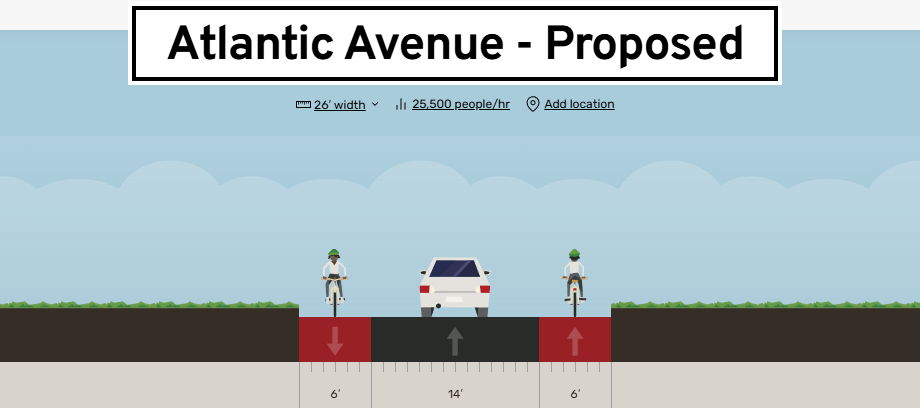
Even with these reduced lane widths it doesn’t leave much room for residents to walk or bike away from automobile traffic. Because of this, Strong Towns Seacoast (STS) wants to propose an edge lane design that would hopefully be able to facilitate walking, biking, and slower traffic.
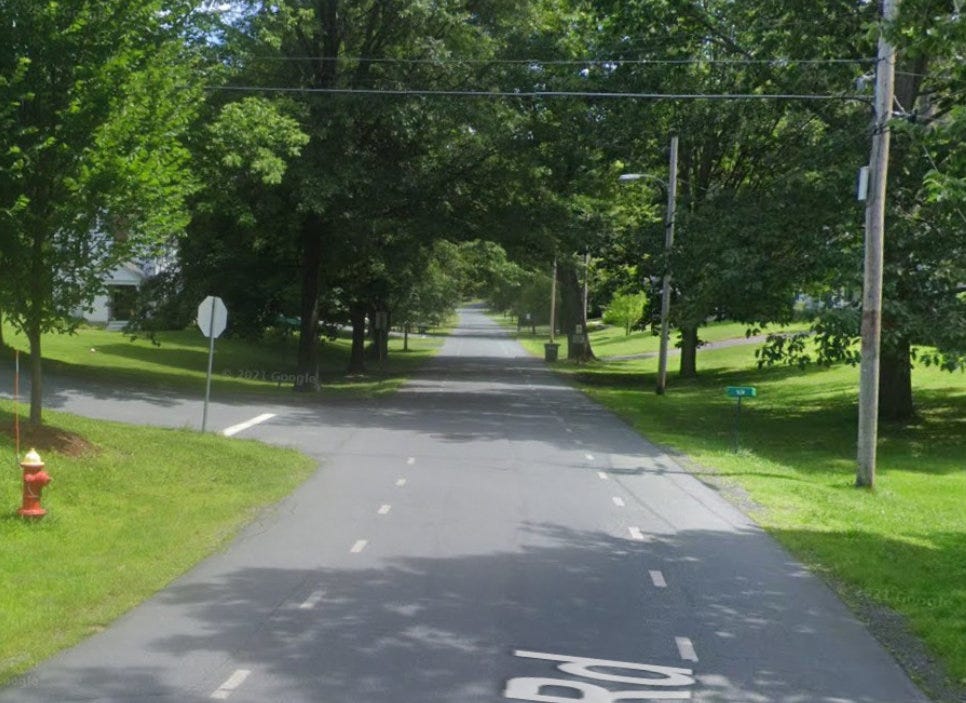
Edge lane designs are streets with a single, bi-directional travel lane and wide edge lanes separated by dashed lines. The aim of the edge lane design is to provide infrastructure that is multipurposed on several levels. The wide shoulders provides a dedicated area for biking and walking along the street and the bi-directional travel lane can be used by automobiles. If two automobiles meet in the travel lane, they can yield to other traffic by pulling over into the edge lane. There are a few examples of edge lanes around New Hampshire and Maine and we think that Atlantic Avenue could be a good case for one due to the restricted width of the street.
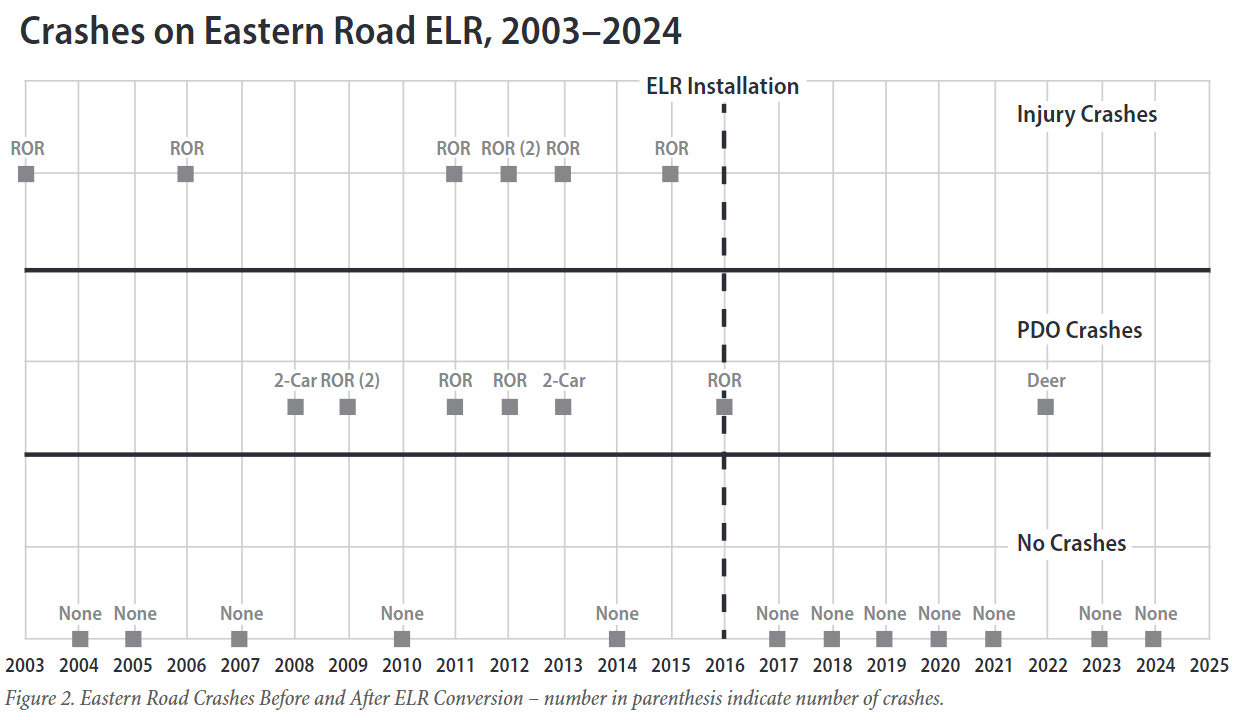
There are some challenges to consider with edge lanes, though. First, they are usually only recommended for streets with low automobile traffic volumes which reduces the chances that they will need to yield to other traffic. This could warrant a traffic study to determine what the current traffic numbers for Atlantic are presently, but there are previous studies done that indicate that numbers a low enough for this design. Second, sharp curves and broken sightlines can prevent oncoming automobile traffic from seeing each other. Atlantic Avenue does have a few gentle curves, but other examples of implemented edge lanes have similar curves and are still successful. We would also want the community of Atlantic Avenue to give their feedback on the edge lane design and we have reached out to their city councilor to see if he can put us into contact so we can discuss it with them.
Horne Street - Ash to Glenwood
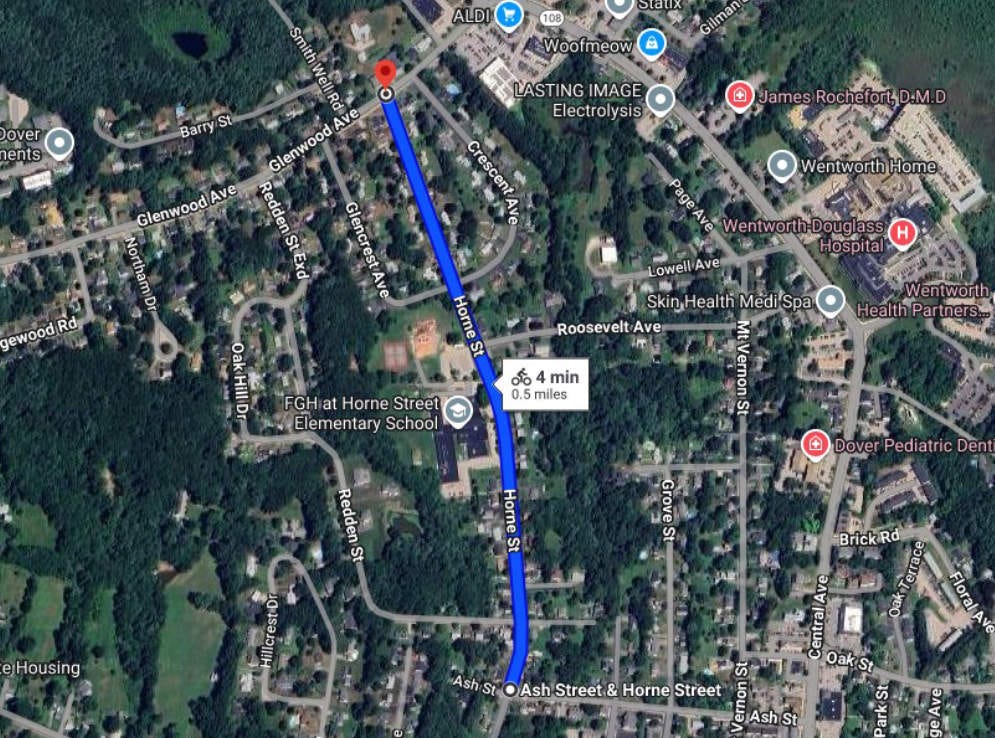
Horne Current Conditions
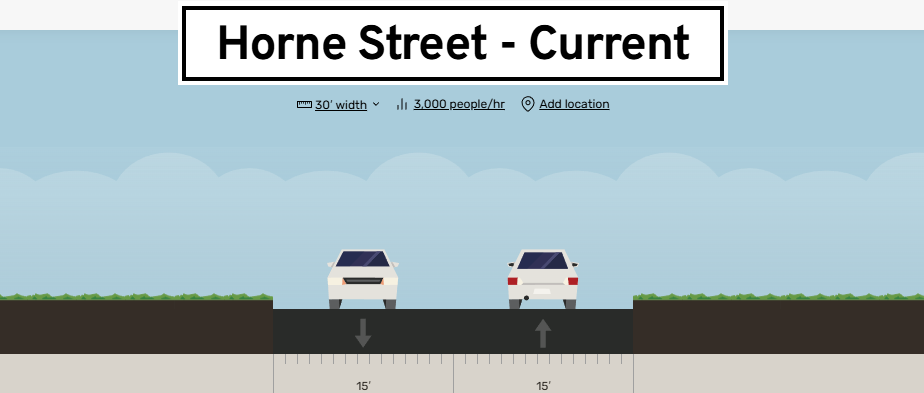
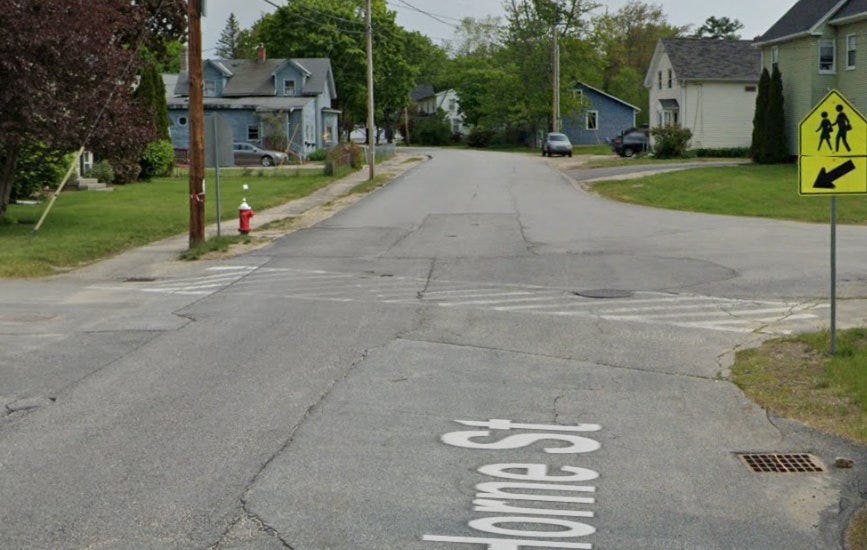
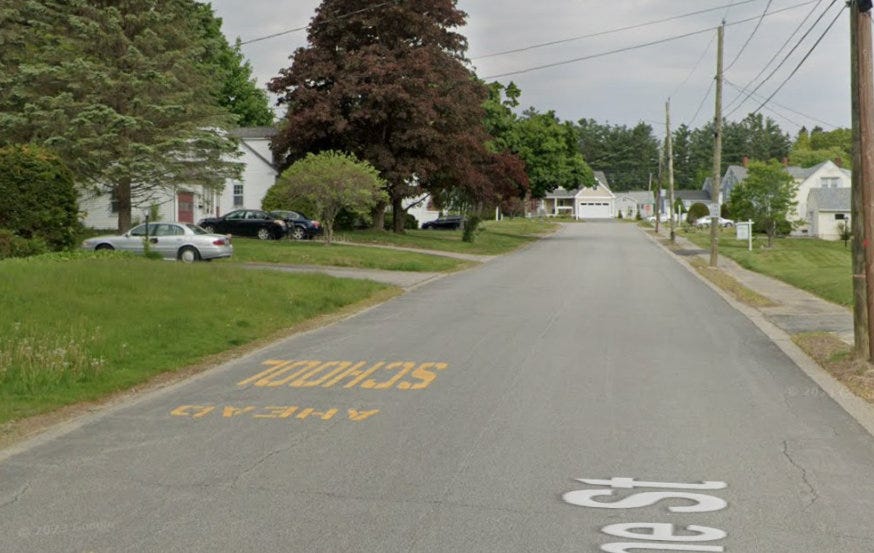
Currently there are no shoulder lines or a centerline on Horne Street. The width of the street varies by a few feet. There is also an elementary school along the street. The BFSG recommends sharrows to this street.
Similar to Atlantic, at Dover’s most recent TAC meeting several families showed up to discuss an agenda item for traffic speeds along Horne Street. The TAC recommended raised crosswalks at Ash Street and Roosevelt, but these will not be implemented likely until the next reconstruction of the street. Though, there is more that can be done here to slow down traffic. Currently there are flashing lights to indicate a speed limit of 20mph during school drop off and pick up, but really we should be trying to maintain those speeds all of the time. Not just during special events in the day.
Recommendations for Horne
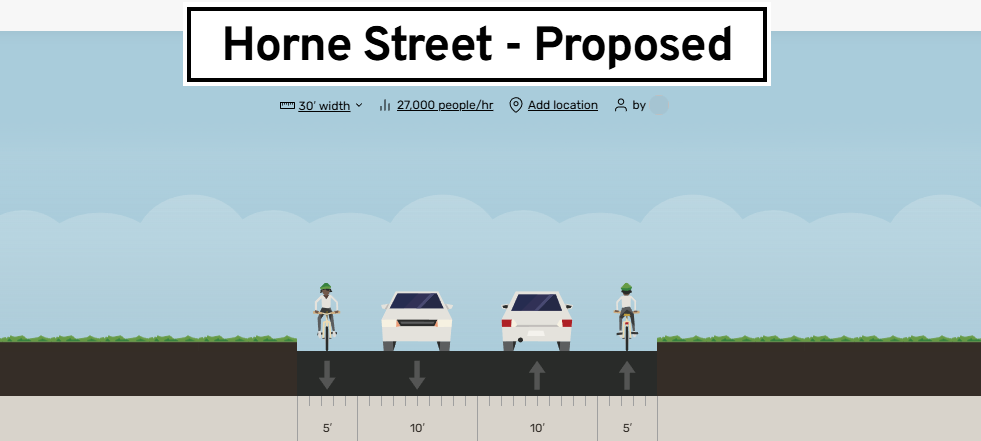
Considering the school on this street and the age of students, we feels that including dedicated bike lanes on either side of the street would have multiple benefits. First it would introduce a constraint on the width of the travel lanes for automobiles. Second, it would give dedicated space to bicycle riders using this street. We believe that these changes would reduce traffic speeds along Horne and also provide a safe place for students to bike to school.
Another similarity to Atlantic is that STS again wants to work with the community. Many parents showed up at the TAC meeting to voice their concerns that the current design of the street is resulting in unsafe and uncomfortable traffic speeds. I have already reached out to a resident of Horne Street and we are trying to set up a meeting with community members to discuss our proposal and get feedback from them to take to the TAC.
Durham Road - Mast to Bridge
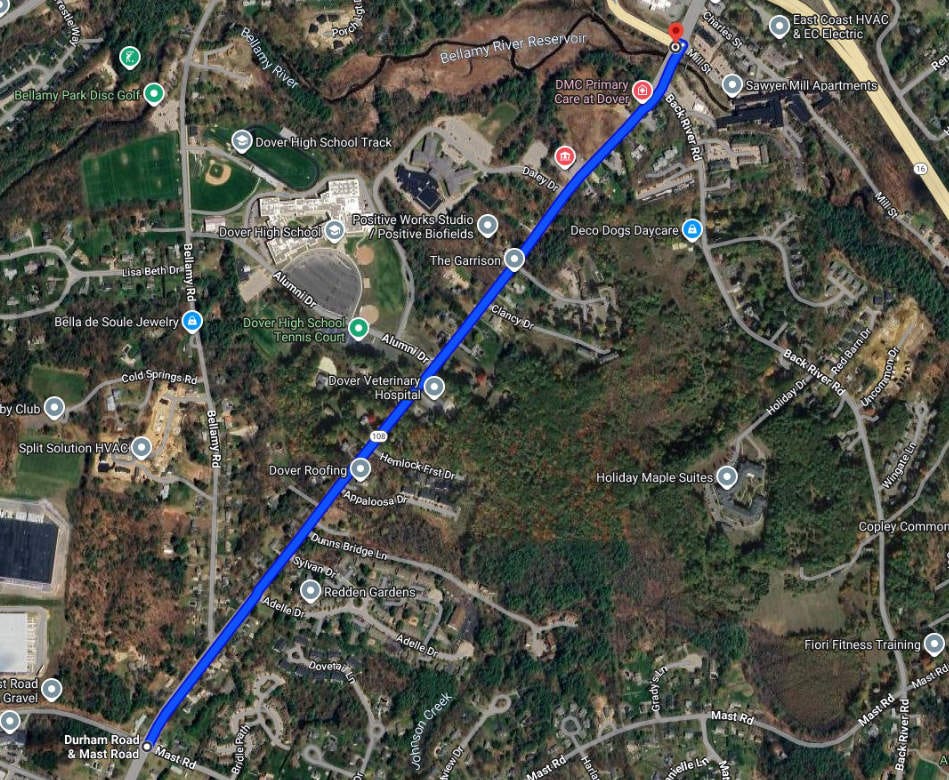
Durham Current Conditions
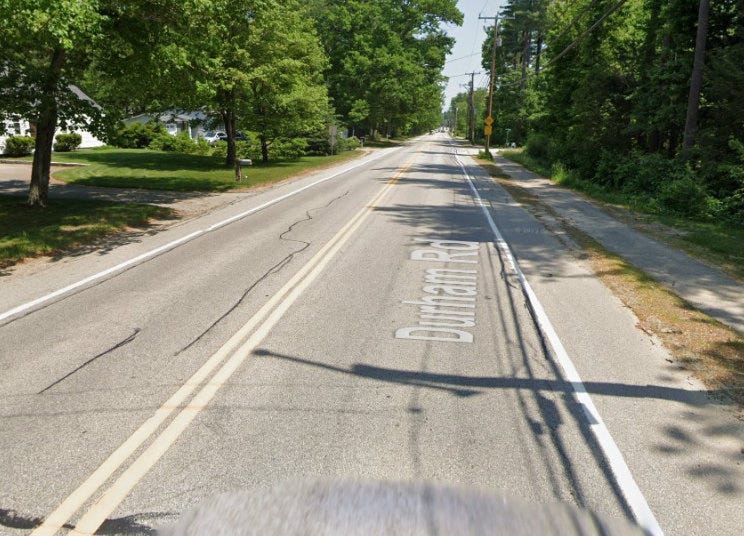
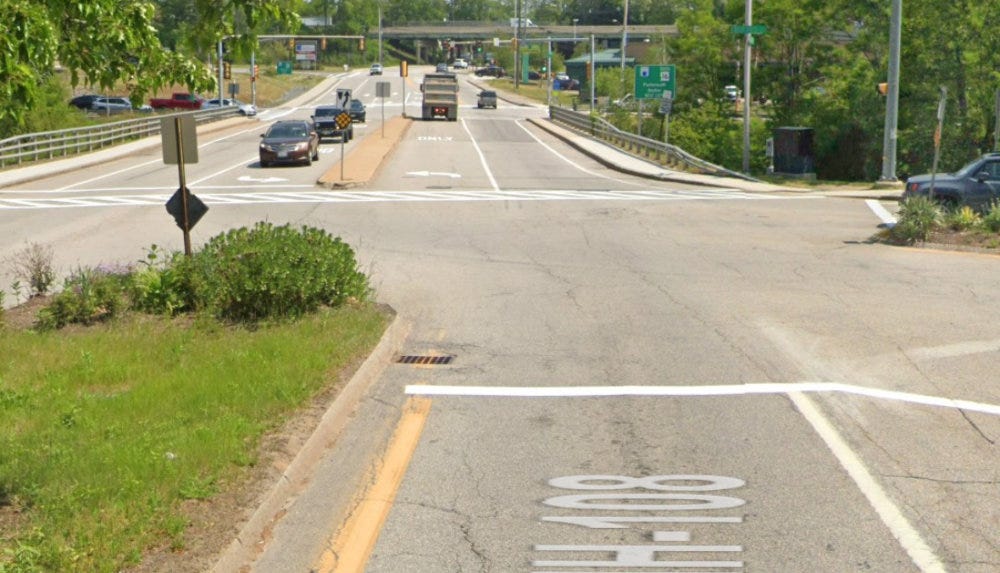
This is a long stretch of repaving that has various widths and street designs. There really isn’t a single design to point to or recommend and we will taking a step-by-step approach on recommendations here when we present to Dover’s TAC. There are many areas that we intend to highlight, but for brevity in this newsletter I want to focus on the lack of dedicated bicycle infrastructure along the designated Wildcat Bike Route. Durham Road is mentioned multiple times in the BFSG, with conflicting recommendations.
Recommendations for Durham
A bike route needs to be friendly to cyclists and this one features 30mph - 40mph traffic next to a shoulder that isn’t always wide enough for a cyclist to use. Since this is a transit corridor as well, recommend narrowing the lanes to a consistent 11’. This will make any extra width available to be used to widen the shoulders into dedicated bike lanes. The width of the street varies and in some places there is just enough room to add in the bike lanes, but not buffers. However, in some areas there are turning lanes or even empty areas that take up width and we encourage the city to evaluate the usefulness of these accessory lanes to consider using that space for buffered bike lanes.
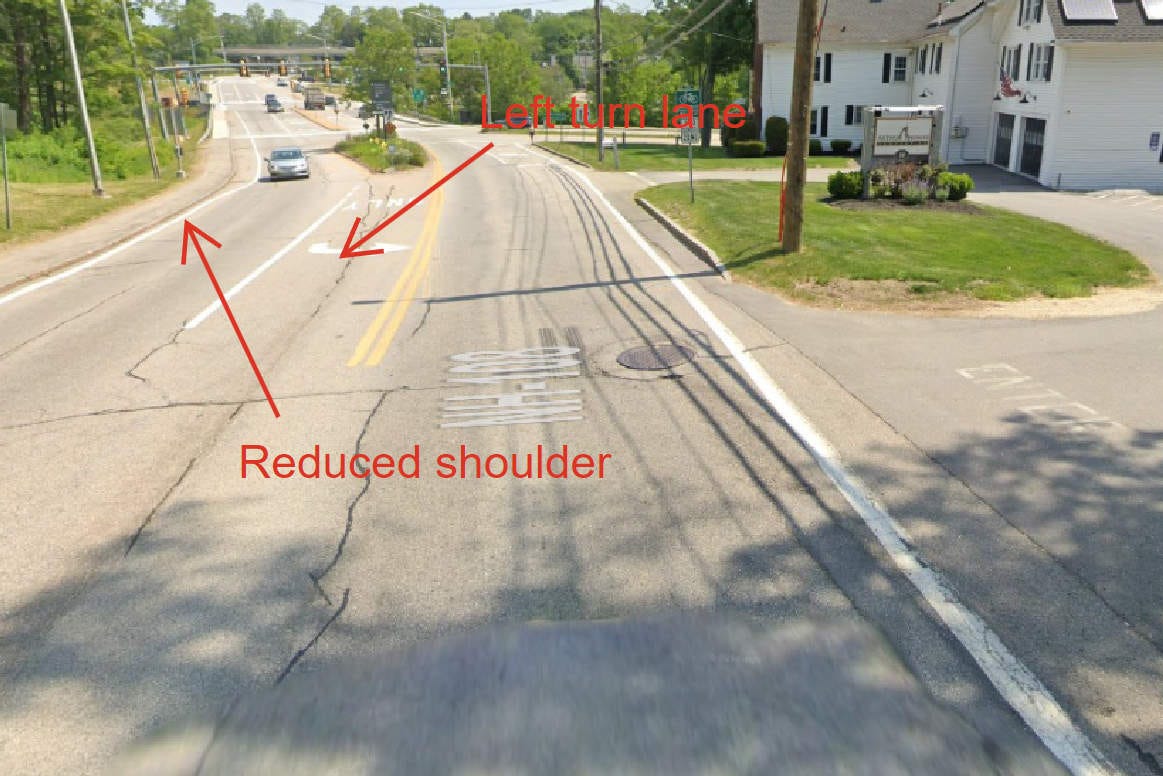
One turning lane in particular only seems to serve a driveway to a private business, and not access to a street. The real problem is that for this lane to be added, the shoulder width of the street was reduced to an unusable state for cyclists. Keep in mind, this is a labeled bike route, with signs along it claiming it as such. How are we to expect cyclists to use this infrastructure safely if we are compromising what little safe space they have available to them? Putting up a sign that says, “Bicycles come here!” without actually giving bicycles a safe place to be is ineffective at best and dangerous at its worst. STS believes that this repaving is an opportunity to refocus Durham Road’s priorities, and actually provide a viable bicycle route.
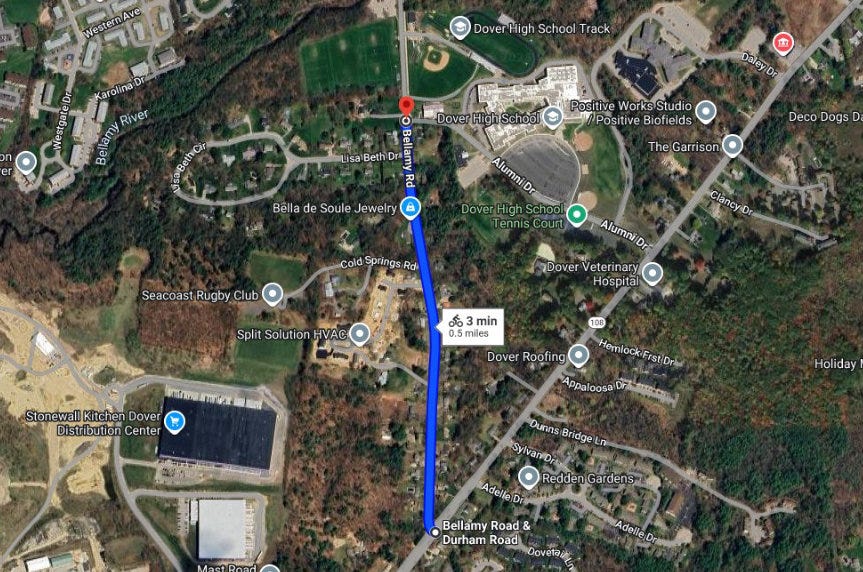
Bellamy Road - Alumni to Durham Road
Bellamy Current Conditions
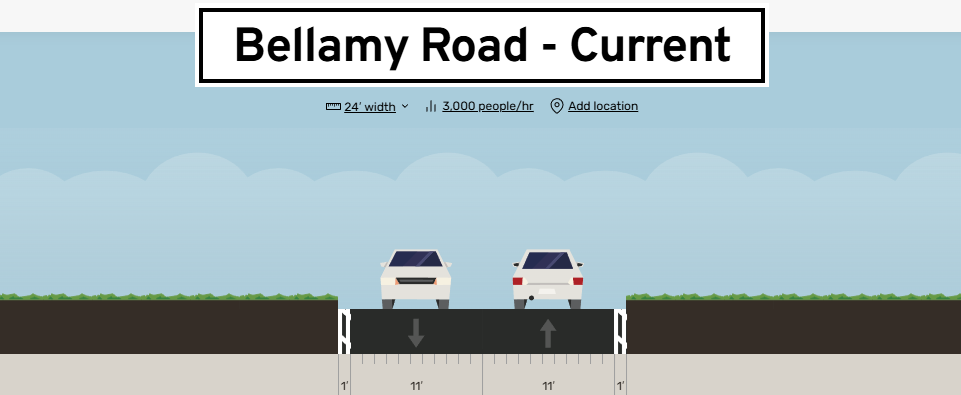
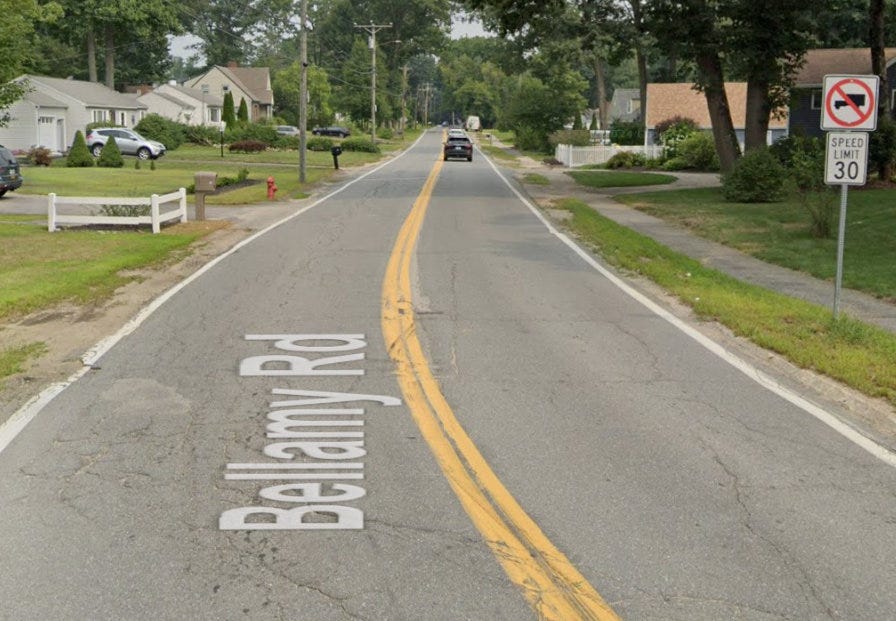
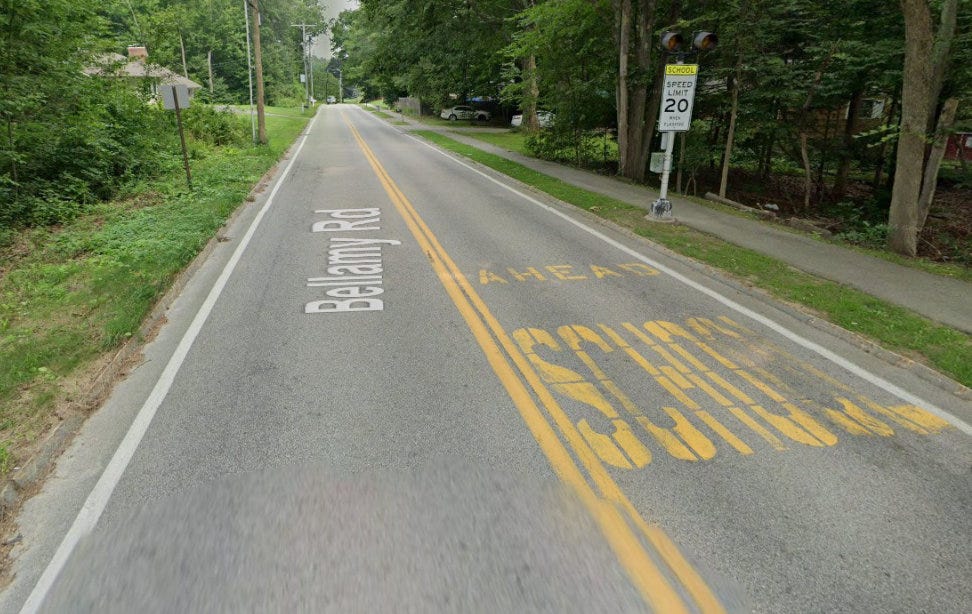
A simple street with 11’ wide lanes and 1’ shoulders. It does connect to Alumni Drive which is where Dover’s High School is located. The BFSG recommends sharrows on Bellamy Road.
Recommendations for Bellamy
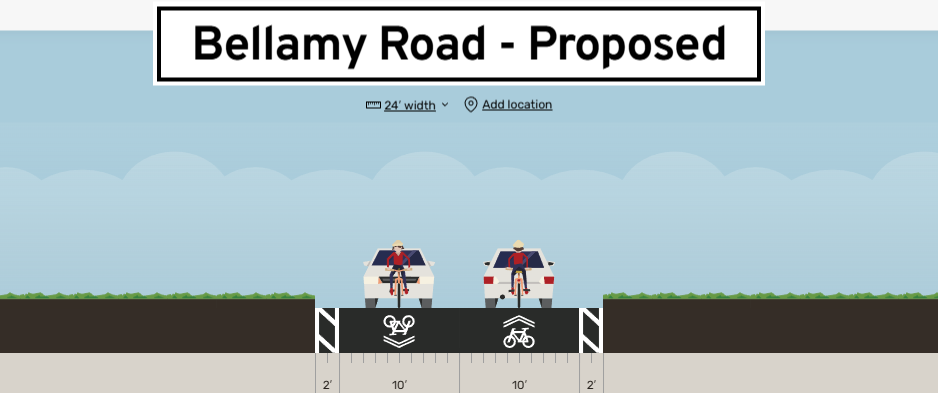
There isn’t really much room to work with here, and definitely not enough space for dedicated bike lanes. Since this is a school route for students who may not have the ability to drive themselves, we feel it is important that bicycle transportation be included. This can be done by adding a sharrow to the street to indicate to cyclists and motorists that the street is a shared space. We also want to recommend narrowing the travel lanes to 10’ for the purposes of traffic calming.
Conclusion
Even though it is just some paint on the ground, the layout and design of a street strongly affects how people interact with it. For decades streets have been designed with a primary focus on free flowing automobile traffic. By simply changing up how the paint is laid out, we can take a street that was built for automobiles and is hostile to people outside of one, and change it into something that is both safer and more versatile. Add in the fact that this can be done with minimal extra cost to the city and there is a lot of opportunity here. I am very excited about that and about the outreach that we will be doing to engage residents of these streets. People are aware of the problems on our streets and constantly point out the dangers that they present to our everyday lives. STS wants to help showcase solutions that address those problems and we will be advocating for these changes at Dover’s next TAC meeting in January; hopefully alongside community members of these streets.
These are great concepts. Piggybacking multimodal improvements onto regular maintenance projects is one of the best things a city can do.
Having the dates of the TAC meeting in the newsletter would be helpful. Thanks.